


Databricks for retail decision support is not only about building faster pipelines or storing more data. Its real value appears when data infrastructure helps commercial teams make better decisions across pricing, inventory, assortment, demand, margin, and channel performance.
Retailers already have data. Usually, they have too much of it.
Sales data sits in POS systems. Inventory data sits in ERP, WMS, or planning tools. Product data sits in PIM systems, spreadsheets, supplier files, PDFs, or slide decks. Pricing and promotion logic may sit in separate systems. E-commerce, marketplace, store, and wholesale data often tell different versions of the same commercial story.
The problem is not simply that retail data is fragmented.
The bigger problem is that fragmented data slows down decisions.
A planner may know that sell-through is weak, but not whether the right response is a markdown, a transfer, a replenishment change, a promotion adjustment, or a product-content improvement. A pricing team may see margin pressure, but not understand whether it is caused by discount depth, channel mix, return exposure, product lifecycle, or stock imbalance. A leadership team may see growth in one channel, but not know whether that growth is actually profitable.
This is where Databricks for retail decision support becomes relevant.
Databricks describes its platform as a unified data and AI platform for analytical and operational workloads, including BI, AI applications, streaming, and data processing on a governed foundation. For retail organizations, that matters because better decisions depend on connecting operational signals, commercial rules, machine-learning workflows, and planner-facing tools into one decision-ready environment.
The goal is not a prettier dashboard.
The goal is a better decision path.
Why Retail Decision Support Needs More Than Reporting
Traditional BI is still essential. Retail teams need dashboards for sales, inventory, margin, stock cover, sell-through, promotions, and channel performance. Power BI, Tableau, and other reporting layers remain important because they help teams align around what happened.
But reporting has a limit.
A dashboard can show that a product is underperforming. It cannot automatically explain whether the issue is demand, price, product content, channel mix, availability, seasonality, return risk, or assortment overlap.
A dashboard can show that inventory is high. It cannot decide whether the best response is markdown, reallocation, replenishment freeze, promotion, bundle, outlet shift, or planner review.
A dashboard can show that marketplace revenue is growing. It cannot confirm whether that growth is profitable after fees, returns, fulfillment cost, markdown exposure, and owned-channel cannibalization.
Retail decision support requires a different operating layer.
It needs connected data, governed definitions, business rules, predictive models, scenario simulation, and workflow logic. This is where Databricks for retail decision support becomes more than infrastructure. It becomes part of the commercial decision architecture.
Why Databricks Fits Retail Decision Support
Retail data has three difficult characteristics.
First, it is highly granular. Decisions often need to happen at SKU, store, market, channel, day, or even transaction level.
Second, it changes quickly. Inventory, pricing, demand, promotions, and digital behavior can shift daily or hourly.
Third, it is commercially interdependent. Pricing affects margin. Inventory affects availability. Product content affects conversion and returns. Channel mix affects profitability. Promotions affect sell-through, but also future demand and margin exposure.
Databricks is relevant because it can support large-scale data engineering, analytics, AI, and machine-learning workflows in one environment. Its retail demand forecasting reference architecture shows how the Databricks Lakehouse Platform can support AI-powered forecasting for retailers. Databricks also offers a demand forecasting solution accelerator designed to help retailers address the limitations of legacy analytics approaches in forecasting workflows.
For BeeBI, the important point is not “Databricks is a platform.”
The important point is what Databricks can enable when implemented well:
stronger demand forecasting, faster scenario simulation, more scalable pricing analytics, better inventory visibility, governed data products, and AI-ready commercial decision support.
From Data Lakehouse to Decision Layer
A retail lakehouse is useful only if it helps the business act.
The technical architecture usually starts by integrating data from ERP, POS, WMS, PIM, e-commerce platforms, marketplace systems, pricing systems, promotion calendars, financial systems, and supply-chain sources.
But integration alone is not enough.
The data then needs to be cleaned, modeled, enriched, governed, and made usable for analytics and decision workflows. Databricks’ medallion architecture describes a layered approach where data quality improves across bronze, silver, and gold layers. In retail terms, this can help move raw operational data toward trusted commercial data products.
A simplified decision-support flow may look like this:
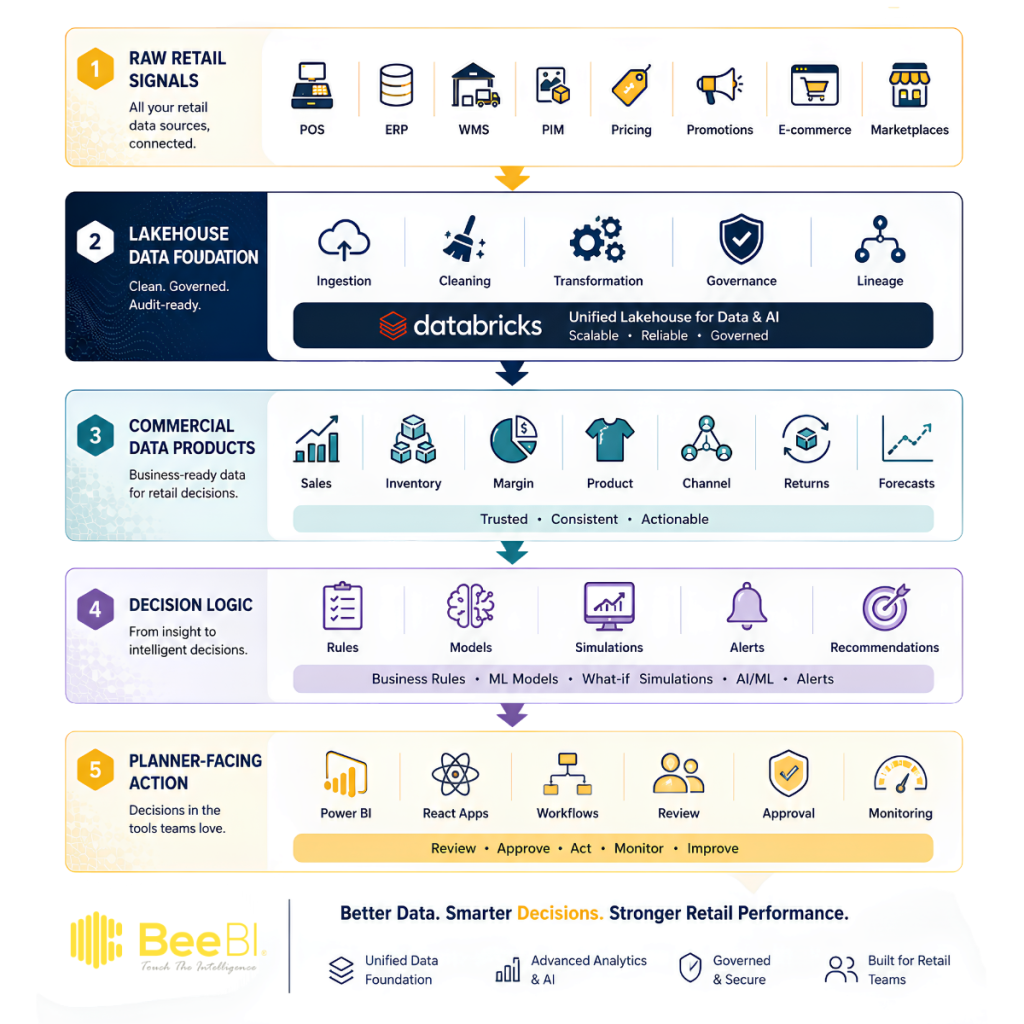
This is the real value of Databricks for retail decision support: not simply storing data, but preparing it for decisions.
Where Databricks Can Support Better Retail Decisions
Databricks can support several high-value retail decision areas.
Demand and Sell-Through Forecasting
Forecasting becomes more useful when it is connected to inventory, channel, market, promotion, and product context. A forecast that says demand may decline is useful. A forecast that helps planners decide whether to replenish, transfer, reprice, or review is much more valuable.
Databricks’ retail demand forecasting reference architecture is directly relevant here because retailers often need forecasting workflows that operate at granular levels and connect with downstream decision processes.
Pricing and Markdown Optimization
Pricing decisions are rarely about demand alone. They involve margin floors, discount bands, MAP rules, product lifecycle, stock exposure, store context, channel economics, and remaining selling window.
BeeBI’s own project experience reflects this. In a retail pricing and markdown optimization project for a global sports retailer, BeeBI worked on SKU-store-day level markdown simulation, a 90-day planning horizon, mixed-effects panel regression, ARMA-based smoothing, a zero-sale classifier, metadata-configurable business rules, Databricks, AWS S3, React planner interfaces, nightly retraining, schema validation, monitoring, and audit-ready outputs.
This is a strong example of Databricks moving beyond data infrastructure into commercial decision support.
Inventory and Allocation Decisions
Inventory decisions depend on demand signals, shipment data, production, replenishment, stock cover, store context, channel behavior, and operational constraints.
In another BeeBI project, a product decision-support system connected inventory, shipment, production, SAP HANA, Azure Synapse Pipelines, and Power BI to improve operational visibility across 875 locations and 50 product types.
That project did not use Databricks as the central platform, but it shows the kind of decision problem Databricks can also support: connecting fragmented operational data into a daily planning environment.
Product Intelligence and Attribute-Based Decisions
Retailers increasingly need to connect product data with commercial outcomes. Product attributes influence search, discovery, conversion, returns, margin, similarity, assortment overlap, and personalization.
BeeBI has worked on image extraction from PowerPoint and PDF files, object detection, foundation-model-supported product attribute prediction, YOLOv8, CLIP-ViT-L-336px, more than 150 attributes, confidence thresholds, and human-in-the-loop validation for product and margin planning.
Databricks can support this type of work by providing the scalable data and ML environment where structured product data, image embeddings, product similarities, and commercial performance can be connected.
Channel Profitability and Commercial Planning
Retailers often compare channels by revenue because revenue is easy to measure.
But better commercial planning requires profitability views that include margin, markdowns, fulfillment cost, returns, marketplace fees, promotions, stock exposure, and cannibalization.
A Databricks-based architecture can help create the trusted data products and modeling workflows needed to compare owned e-commerce, stores, outlets, wholesale, and marketplace channels more accurately.
That is where Databricks for retail decision support becomes strategically important: it helps commercial teams move from channel reporting to channel decision-making.
Databricks and Agentic Analytics
Agentic AI adds another layer to the retail analytics conversation.
If AI agents are expected to monitor performance, compare scenarios, prepare recommendations, or trigger workflows, they need access to trusted data, governed definitions, business rules, tools, and monitoring.
Databricks documentation describes tools for building, deploying, and managing AI agents, including MLflow for tracing, evaluation, and human feedback. Databricks also positions Agent Bricks as a control plane for governance, management, monitoring, and observability across enterprise AI agents.
For retail, that matters because agentic analytics cannot operate on messy context.
An AI agent recommending a markdown needs to understand sell-through, stock position, margin thresholds, MAP rules, seasonality, discount bands, channel performance, and planner approval logic.
An AI agent reviewing product content needs to understand attributes, images, descriptions, search behavior, conversion, returns, and similarity.
An AI agent monitoring channel profitability needs to understand fees, return rates, fulfillment costs, promotions, markdowns, and cannibalization.
This is why Databricks for retail decision support should be seen as part of the agentic analytics foundation. The platform can help connect the data and AI layers, but the business still needs decision rules, governance, human review, and measurable workflows.
No retailer should simply release a squad of AI agents into pricing, inventory, and promotions and hope they behave like tiny CFOs in matching jackets.
Governed decision architecture still matters.
The Role of Power BI, Azure, AWS, Snowflake, and the Wider Stack
Databricks rarely exists alone.
In real retail environments, it often sits alongside cloud platforms, BI tools, ERP systems, and other data platforms. A practical architecture may involve Databricks for data engineering, ML, feature preparation, and simulation; AWS S3 or Azure storage for data lake storage; Snowflake or other warehouses for specific analytical workloads; Power BI for executive and planner dashboards; and React-based interfaces for workflow-heavy use cases.
The point is not to declare one platform as the entire answer.
The point is to design the architecture around the decision.
For example:
- if the decision is markdown optimization, the architecture needs pricing, elasticity, inventory, margin, rules, simulation, and approval workflow;
- if the decision is inventory allocation, it needs demand, stock, replenishment, shipment, location, and planner visibility;
- if the decision is product discovery, it needs product attributes, embeddings, search behavior, conversion, and content quality;
- if the decision is channel profitability, it needs revenue, cost, returns, fees, margin, promotions, and customer behavior.
Databricks can be a powerful part of that architecture, but the business value comes from how the platform is connected to commercial workflows.
What a Databricks Retail Decision-Support Architecture Needs
A strong Databricks retail decision-support architecture should include seven layers.
The first is source integration: ERP, POS, WMS, PIM, pricing, promotions, e-commerce, marketplaces, customer data, and financial systems.
The second is lakehouse governance: data quality, access control, lineage, metadata, and trusted data products.
The third is commercial modeling: product, store, channel, customer, inventory, margin, and promotion models.
The fourth is machine learning and forecasting: demand forecasting, price elasticity, stockout risk, return prediction, product similarity, and anomaly detection.
The fifth is business rules and constraints: margin floors, discount limits, approval thresholds, category rules, seasonal restrictions, and operational constraints.
The sixth is decision interfaces: Power BI dashboards, planner applications, alerts, APIs, React frontends, and workflow tools.
The seventh is monitoring and feedback: model performance, data drift, recommendation outcomes, planner overrides, audit trails, and continuous improvement.
This is the difference between a data platform and a decision platform.
The first makes data available.
The second helps the business decide.
Common Mistakes When Using Databricks in Retail
The first mistake is treating Databricks as an IT modernization project only.
Modern infrastructure matters, but a retail platform should be designed around commercial outcomes: better pricing, better allocation, better forecasting, better margin visibility, better product intelligence, and better channel decisions.
The second mistake is building data pipelines without business rules.
A model may recommend an action that is statistically valid but commercially unacceptable. Retail decisions need constraints: margin thresholds, MAP rules, discount bands, seasonality, stock limits, brand positioning, and approval logic.
The third mistake is stopping at dashboards.
Dashboards show what happened. Retail decision support should help teams understand what to do next.
The fourth mistake is ignoring workflow design.
If recommendations do not fit how planners, merchandisers, pricing teams, and category managers work, adoption will suffer. The best model in the world is not useful if no one trusts it, understands it, or knows when to act on it.
The fifth mistake is preparing for AI agents before fixing the data foundation.
Agentic analytics requires trusted data, semantic definitions, governance, and decision logic. Without those foundations, agents only automate confusion. Very confidently. Which, let’s be honest, is the most dangerous flavor of confusion.
BeeBI’s View: Infrastructure Should Lead to Better Decisions
At BeeBI, we see Databricks for retail decision support as more than a platform implementation topic.
The real question is not:
How do we move data into Databricks?
The better question is:
Which commercial decisions should Databricks help improve?
That changes the design.
Instead of starting only with pipelines, tables, and dashboards, the work starts with decision flows: pricing decisions, markdown decisions, replenishment decisions, product-content decisions, assortment decisions, promotion decisions, and channel-profitability decisions.
Then the architecture can be designed around those decisions.
That may include Databricks, AWS, Azure, Snowflake, SAP HANA, Power BI, ERP integration, POS data, PIM systems, lakehouse architecture, ML pipelines, semantic models, business-rule engines, planner-facing applications, and agentic analytics workflows.
The strongest outcome is not a more impressive data stack.
It is a commercial team that can act earlier, with better context, stronger governance, and clearer options.
That is what better retail decision support should deliver.
Ready to Turn Retail Data Infrastructure into Better Decisions?
If your organization is investing in Databricks, the next question is whether that investment is improving the decisions that matter most.
BeeBI helps retail and consumer-goods teams connect data architecture, analytics, AI, and decision workflows. We design the foundations for demand forecasting, pricing optimization, inventory visibility, product intelligence, channel profitability, and agentic analytics.
Reach out to BeeBI Consulting to explore how Databricks can support better commercial decisions across your retail organization.