



Germany’s digital transformation often moves deliberately. While global organizations accelerate investments in AI and automation, many German enterprises prioritize reliability, governance, and operational precision over speed.
However, even well-planned automation initiatives often struggle to deliver the expected results.
Across industries, organizations continue to invest in automation for supply chains, pricing and operational analytics. However, without unified data foundations, even the most careful implementations fail to deliver and teams drown in manual work reconciling spreadsheets and mismatched systems.
Why Automation Initiatives Stall
Automation is only as good as the data feeding it. In practice, many organizations operate with:
• inconsistent KPI definitions across teams and regions
• fragmented product and business hierarchies
• reporting environments built around manual consolidation
• operational signals that refresh too slowly for coordinated decision-making
When these conditions exist, automation does not simplify operations. It amplifies complexity. For instance:
- Pricing teams optimize against different commercial metrics than merchandising teams
- Inventory mismatches triggering inaccurate demand forecasts
- Slow data pipelines causing teams to make decisions on outdated operational information
As a result, automation initiatives frequently succeed in small pilot environments but struggle when scaled across multiple markets or operational domains.
Without a unified data foundation, automation becomes an expensive experiment rather than a reliable operational capability.
From Static Reporting to Operational Analytics
Organizations that successfully scale automation take a different approach. Instead of starting with models, they begin with data architecture and governance.
In one large international client we supported, business teams across more than a hundred regional entities relied on different reporting tools, KPI definitions and spreadsheet-based consolidation processes.
Each system worked locally.
But at the global level, decision-making was fragmented.
Management teams often spent days reconciling data from different reports before performance discussions could even begin.
To address this challenge, the objective was not to introduce yet another dashboard.
Instead, the focus shifted toward building a centralized performance steering system capable of consolidating and governing operational KPIs across the entire organization.
The platform integrated signals from multiple operational domains, including:
• sales and financial performance metrics
• operational business KPIs across regional entities
• consolidated reporting structures for executive steering
• historical performance snapshots for consistent trend analysis
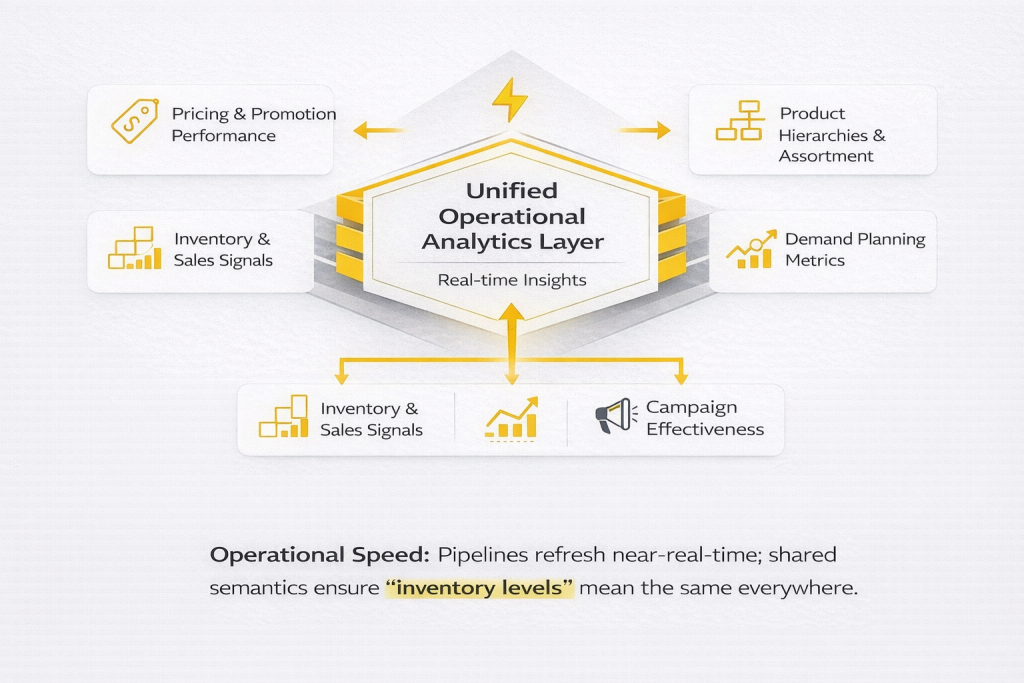
More than 150 KPIs across over 120 organizational units were harmonized into a single analytical environment.
Technically, this required:
• integrating multiple enterprise data sources into a centralized Azure-based data platform
• implementing governed KPI definitions to ensure consistent interpretation across regions
• building performance-optimized snapshot tables to support scalable reporting
• enabling role-based access controls for different management layers
• delivering interactive dashboards through Tableau for executive and operational users
Rather than replacing reporting, the system created a single governed layer for performance analysis across the organization.
Real Results: What Alignment Unlocks
Post-implementation:
- Pricing models ran on consistent structures (no more manual KPI mapping)
- Planning teams synced inventory signals, cutting stockouts
- Decisions accelerated means trusted data = faster action
| Challenge | Pre-Alignment | Post-Unified Data Layer |
|---|---|---|
| KPI Definitions | Varied by region and reporting team | Harmonized KPI governance across the organization |
| Reporting Process | Manual consolidation of Excel reports from multiple systems | Centralized BI platform with automated data pipelines |
| Data Refresh | Monthly reporting cycles prepared manually | Automated monthly snapshot refresh with validated datasets |
| Data Validation | Manual cross-checking across reports | Automated anomaly detection |
| Organization Visibility | Fragmented reporting across business units | Unified performance view across 120+ entities and 150+ KPIs |
BeeBI’s Approach: Data Environments That Scale Automation
At BeeBI Consulting, we start each of our client use-cases with the right foundations:
- Building scalable data architectures
- Harmonizing business semantics across systems and markets
- Designing data pipelines optimized for reporting reliability and performance
- Implementing governance layers that ensure consistent KPI interpretation
Automation Is the Final Layer. Start with Infrastructure!
Before your next AI investment, ask yourself : Does your data foundation automation eliminate manual work or just create more sophisticated spreadsheets?
Ready to build your success story? Reach us out here and let BeeBI Consulting turn data chaos into automation wins!