


What Power BI Copilot Reveals About Your Foundation
Dashboards are not dead. They just got a co-pilot and that co-pilot is exposing something most analytics teams already knew but could quietly avoid. If your KPI definitions, semantic models and data foundations are not in order, agentic analytics will not solve the problem. It will scale the confusion.
From “What happened?” to “What should we do next?”
Dashboards gave business teams a shared view of performance. Sales, margin, inventory, availability, conversion, forecast accuracy and profitability became visible across functions, markets and teams. That was genuinely valuable – and it remains so.
The next expectation is more demanding. Once people see the number, they want the movement behind it, the context around it and the decision that should follow.
A margin decline in Germany last month may involve pricing, promotions, markdowns, product mix, returns, stock exposure, fulfilment costs, channel shifts or demand changes. Each of those drivers may sit in a different system, owned by a different team, measured with a different definition.
The shift is not from dashboards to AI.
It is from reporting what happened – to understanding why – to recommending what to do next.
Conversational analytics and Power BI Copilot make this expectation feel achievable. But the quality of the answer depends entirely on the structure behind the question.
What Power BI Copilot Actually Requires to Work
Microsoft positions Power BI Copilot as a way for users to ask questions, summarise reports, analyse visuals and interact with semantic models in natural language. Microsoft also highlights the role of AI instructions, verified answers and semantic model preparation in improving the relevance and accuracy of AI-driven insights.
The interface is only the visible part.
When a business user asks “Why did margin drop in Germany last month?”, the system needs to understand:
- Which margin definition is approved for this context
- Which calculation logic applies to that product category or market
- Which data sources are included and which are excluded
- Which filters are valid at this level of granularity
- Which business context should shape the answer, not just the data
A technically correct query can still produce a poor business explanation when the underlying definitions are unclear. Copilot does not invent that clarity. It relies on finding it in the semantic model.
The Risk: AI That Is Confident, Fast and Wrong
Finance, Sales, Merchandising and Supply Chain often use different definitions for margin, availability, conversion or performance. These differences already create friction in meetings, report reviews and Excel exports. Conversational AI makes that friction faster and more visible.
A confident answer based on the wrong definition, the wrong grain or incomplete context is still a wrong answer delivered at speed, at scale, and with the appearance of authority.
This is the core risk in AI-enabled analytics: speed without trusted context. The business does not know the answer is wrong until a decision has already been made on it.
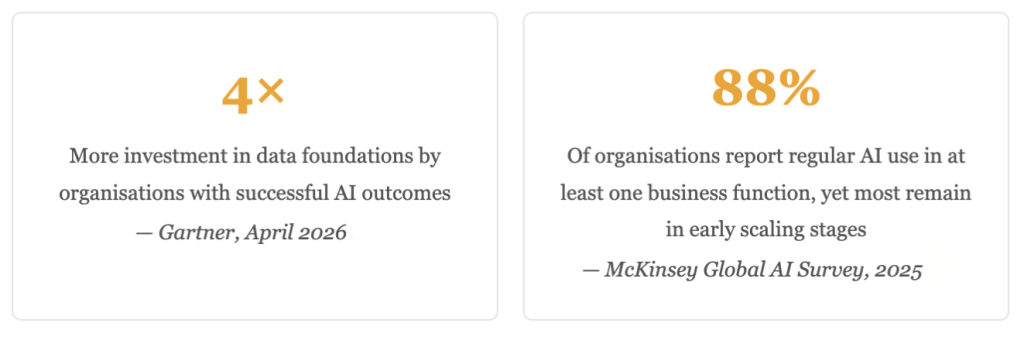
Gartner found that organisations with successful AI initiatives invest up to four times more in data and analytics foundations – including data quality, governance, AI-ready talent and change management – compared with organisations seeing poor AI outcomes.
McKinsey’s 2025 global AI survey shows widespread adoption, but the organisations moving beyond experimentation share a pattern: they redesign workflows, embed AI into business processes, track value through KPIs and invest in the foundations that support adoption.
Copilot as a Diagnostic, Not Just a Feature
For analytics leaders, the practical implication is this: Power BI Copilot is a test of whether the business has prepared its data, KPIs and logic for AI-assisted reasoning.
Where Copilot struggles to answer consistently, the problem is rarely the AI. It is the analytics foundation it is working from. Inconsistent metric definitions, ungoverned semantic models, missing business rules and disconnected data pipelines all become visible the moment a user expects a reliable, context-aware answer.
This diagnostic function is genuinely useful. It surfaces the gap between what the business needs from its analytics and what the architecture currently supports.
What Agentic Analytics Demands from Your Foundation
Agentic Analytics raises the bar further still. An analytics agent that detects changes, investigates root causes, evaluates scenarios and recommends actions needs:
- Reliable data pipelines — clean, current, connected
- Consistent KPI definitions — governed, agreed, documented
- Semantic models that encode business meaning, not just data structure
- Lineage — so the agent can trace where a number came from
- Governance — so the agent knows which definitions are approved
- Business rules and decision logic that reflect how the organisation actually operates
An agent that cannot distinguish between an approved margin definition and a locally constructed one will produce recommendations that feel credible but are built on inconsistent ground. The foundation does not become less important when the AI becomes more capable. It becomes more important.
Agentic Analytics starts before the agent.
It starts with the trusted context the agent will reason from.
What Trusted Intelligence Looks Like in Practice
The value of a well-built analytics foundation is a shorter, more reliable path from signal to decision. In practice, that means:
Finance
A finance team should understand whether a margin change came from price, volume, product mix or cost pressure — without building a separate analysis or waiting for a data team to investigate.
Merchandising
A merchandising team should see whether markdowns are protecting revenue or eroding profitability — based on a consistent margin definition that all functions agree on.
Supply Chain
A supply chain team should connect stock exposure, demand shifts and allocation logic before operational impact grows – not after the markdown or write-off has already happened.
Executive Leadership
An executive team should receive explanations grounded in approved metrics, not scattered interpretations pulled from different reports built on different assumptions.
Dashboards will continue to matter when they sit on models people trust. Copilot changes what users expect from those dashboards. Agentic Analytics changes what the underlying architecture must support.
How BeeBI Consulting GmbH Builds the Foundation
At BeeBI Consulting GmbH, we help organisations build the layers that make conversational and agentic analytics usable in real business settings. We work with enterprise clients in retail, eCommerce, building materials and logistics to establish the foundations AI needs to reason reliably.
Our analytics foundation services include:
- Governed KPI frameworks: agreed metric definitions across Finance, Sales, Merchandising and Supply Chain
- Semantic business layers: Power BI semantic models that encode business context, not just data structure
- Power BI and Tableau reporting foundations: built on models analytics teams and business users can trust
- Analytics engineering: DAX optimisation, star schema design, aggregation strategies, incremental refresh
- Pricing, forecasting and inventory intelligence: demand forecasting, markdown optimisation, allocation logic, scenario simulation
- Decision-support systems on modern data platforms: Microsoft Fabric, Azure Synapse Analytics, Databricks, Snowflake
The organisations that benefit most from AI-enabled analytics treat it as a foundation project: clear KPIs, clean models, connected context, governed logic and systems prepared for questions that cross functions and time horizons.
Before AI Can Support Decisions, the Context Must Be Trusted
The future is not more dashboards. The future is not more AI noise. The future is trusted intelligence that connects data to decisions, across Finance, Merchandising, Supply Chain and Executive leadership, grounded in definitions everyone agrees on.
Before AI can recommend an action, it needs context it can trust. Before an agent can investigate a root cause, it needs a model that encodes how the business defines success. Before Copilot can answer reliably, the semantic model needs to be ready.
That is the real foundation for Agentic Analytics. And it is the work that matters most before the agent becomes useful.
Is your analytics foundation AI-ready?
BeeBI Consulting GmbH works with enterprise analytics teams to build the KPI frameworks, semantic models and data foundations that make Power BI Copilot and Agentic Analytics reliable in practice.
Frequently Asked Questions
What is Agentic Analytics?
Agentic Analytics refers to AI-driven analytics systems that detect changes in business data, investigate root causes autonomously, evaluate scenarios and recommend or execute actions without a human formulating each query. It requires reliable data pipelines, consistent KPI definitions, governed semantic models, lineage tracking and embedded decision logic
What does Power BI Copilot need to work well?
Power BI Copilot requires a well-prepared semantic model that includes approved metric definitions, consistent calculation logic, valid filter contexts, business glossaries and AI instructions. Without these foundations, Copilot may return technically correct queries that produce poor or misleading business explanations.
Why do inconsistent KPI definitions matter for AI analytics?
When Finance, Sales, Merchandising and Supply Chain use different definitions for margin, availability, conversion or performance, conversational AI scales that inconsistency. A confident AI answer based on the wrong definition, wrong grain or incomplete context is still a wrong answer delivered faster and at greater scale.
What analytics foundation do you need before deploying an AI agent?
Before deploying an analytics agent, organisations need: (1) governed KPI frameworks with agreed definitions across functions; (2) semantic business models that encode business logic, not just data structure; (3) clean, reliable data pipelines; (4) lineage and governance documentation; (5) embedded business rules and decision logic that reflect how the organisation operates.