


Agentic AI changes the role of enterprise data.
For years, analytics helped organizations understand what happened. Dashboards, reports, KPIs, and visualizations supported human decision-making. Business users looked at data, interpreted the situation, and decided what to do next.
Agentic AI moves the enterprise closer to a different operating model.
AI systems are increasingly designed to interpret context, recommend actions, call tools, trigger workflows, and coordinate across applications with defined levels of autonomy. That shift creates a new challenge for CIOs, CTOs, Heads of Data, and Digital Transformation leaders.
The question is no longer only whether AI can produce a useful answer but whether the organization can govern what happens after that answer.
This is where decision intelligence becomes critical.
From Analytics to Action
Traditionally, business intelligence revolves around visibility. It helped organizations monitor performance, explain variance, and identify risks or opportunities.
Agentic AI, on the other side builds on movement.
It can suggest the next step, initiate a process, escalate an exception, update a record, or coordinate with another system. For retail, that might mean recommending a stock transfer before a stockout occurs. In finance, it might mean flagging a forecast anomaly and triggering a review workflow. In the operations realm, it might mean adjusting capacity planning based on demand, inventory, supplier, and weather signals.
This is powerful, but it also changes the risk profile.
When AI stays inside analysis, weak governance creates confusion. When AI enters execution, weak governance creates operational risk.
A dashboard can be wrong and still leave room for human correction. An agent acting on incomplete context can move the problem directly into the business process.
The Missing Layer Is Decision Architecture
Most organizations already have some form of data architecture. Many have reporting governance. Some have AI governance. Far fewer have a clear architecture for decisions.
That gap becomes visible as agentic AI scales.
A decision is rarely just a model output. It has inputs, assumptions, business rules, constraints, owners, approval paths, timing, exceptions, and consequences. It may involve structured data from ERP or CRM systems, semi-structured knowledge from documents or tickets, external signals, historical patterns, and human judgment.
Without a decision architecture, each AI use case defines these elements locally.
One team builds its own recommendation logic. Another defines its own approval flow. A third creates a separate agent with different thresholds, data sources, and escalation rules. Each solution may work in isolation, but the organization gradually creates a new layer of decision fragmentation.
Agentic AI does not remove the need for structure.
It makes structure non-negotiable.
Decision Intelligence Makes Agentic AI Observable
Decision intelligence provides the operating framework for how decisions are designed, executed, monitored, and improved.
It connects data, models, rules, workflows, human oversight, and feedback loops into one decision system. ThoughtSpot’s 2026 data and AI trends report describes the shift from one-off insights toward repeatable decision stages: data, analysis, simulation, action, and feedback. It also points to the emergence of decision systems of record, where inputs, model versions, recommendations, actions, outcomes, and owners can be logged and improved over time.
For enterprise leaders, this is the practical value: decision intelligence makes agentic AI observable.
It helps answer the questions that matter once AI starts acting inside the business. What data did the agent use? Which rule or threshold shaped the recommendation? Do we require human approval? Any taken action? What happened afterward? Did the decision improve the business outcome? Should we adjust the logic?
These are not administrative details.
They are the basis for trust.
Without them, agentic AI becomes difficult to audit, difficult to improve, and difficult to defend.
Autonomy Needs Levels
Not every decision should have the same level of AI autonomy.
Some decisions should remain fully human-led. Others can be AI-assisted: where the system predicts, ranks, or recommends. Some may be human-approved before execution. A smaller set may eventually become autonomous within clearly defined boundaries.
ThoughtSpot’s eBook compares this to autonomy levels, ranging from fully manual decisions to AI systems that make decisions within defined guardrails, monitor outcomes, and learn from feedback.
This matters because agentic AI is not one category of risk.
An internal knowledge agent that summarizes a policy document is different from an agent that updates customer records, initiates payments, changes replenishment priorities, or recommends production schedule adjustments.
The more directly an agent affects operations, customers, cost, compliance, or revenue, the stronger the decision architecture needs to be.
Autonomy, therefore should be granted and earned through data trust, process clarity, monitoring, and business accountability, rather than through a model that appears capable.
Agentic Infrastructure Increases the Need for Governance
The technical foundation for agentic AI is also changing.
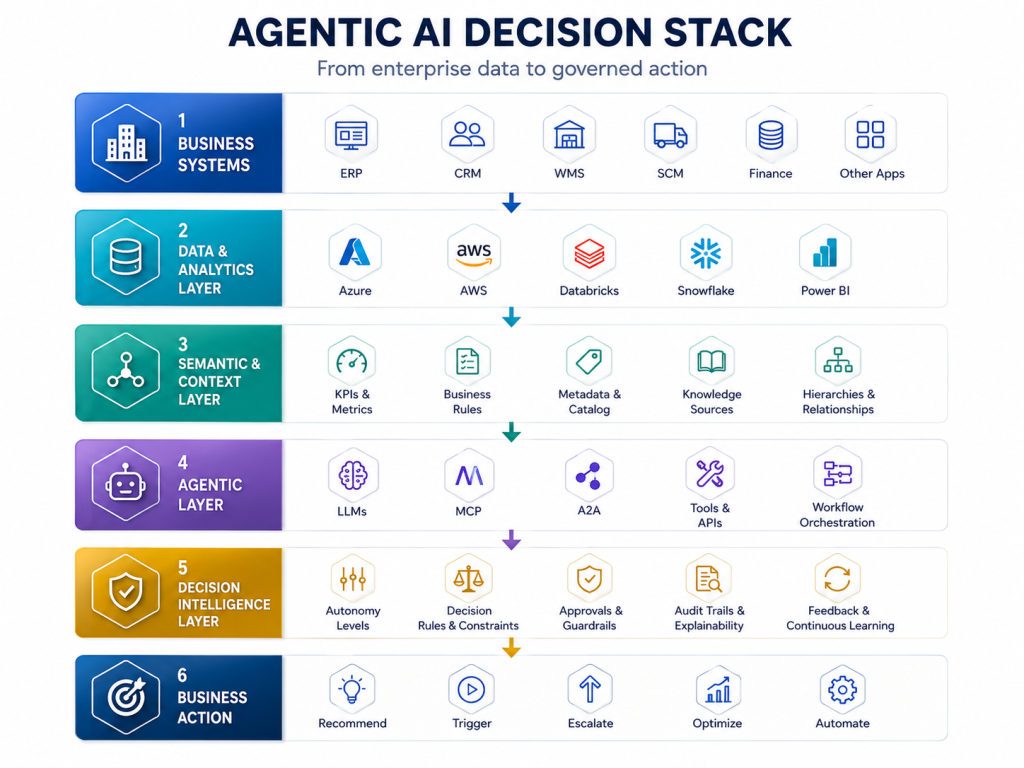
Protocols such as MCP and A2A are emerging to help AI systems connect with tools, data sources, and other agents. Anthropic describes MCP as an open standard for secure two-way connections between AI-powered tools and data sources, while Google describes A2A as a protocol that allows agents to communicate, exchange information, and coordinate actions across enterprise platforms.
This matters because agentic AI will not operate in one isolated application.
It will increasingly depend on integrations across business systems, data platforms, semantic layers, APIs, and workflow tools. In practice, this agentic infrastructure may sit across Azure, AWS, Databricks, Snowflake, Power BI, ERP systems, CRM platforms, data warehouses, lakehouse architectures, semantic layers, APIs, and workflow orchestration tools.
The specific stack will vary, but the architectural requirement is consistent: AI agents need trusted data access, governed business context, permission boundaries, observable workflows, and cost-aware execution.
The organization needs to define which agent can access which data, which actions require approval, how handoffs are logged, where exceptions go, and who owns the outcome.
Tool access without decision governance is not agentic maturity.
It is a faster way to scale uncertainty.
Why This Matters for Retail and Operations
Retail and supply chain environments make the issue concrete.
A stock allocation decision may depend on sales velocity, inventory levels, shipment data, production constraints, regional demand, promotions, and seasonality. A pricing decision may depend on margin targets, competitor movement, stock exposure, channel strategy, and customer behavior. A replenishment decision may depend on forecast confidence, supplier reliability, lead times, and service-level priorities.
These decisions are too important to leave as black-box recommendations and they also move too fast to remain trapped in manual reporting cycles.
Decision intelligence gives organizations a way to structure the middle ground: AI-supported decisions that are fast, explainable, governed, and connected to measurable outcomes.
This is where agentic AI becomes valuable. It does not only replace operational expertise but it helps, at the same time, decision-makers act earlier, with better context and clearer boundaries.
BeeBI’s View: Agentic AI Starts with Decision Readiness
At BeeBI, we see agentic AI as a decision-readiness challenge.
Before an organization gives AI more autonomy, it needs to understand which decisions are worth improving, which data sources can be trusted, which rules must be respected, which actions require approval, and how outcomes will be measured.
That work sits across data architecture, business intelligence, cloud platforms, semantic models, KPI governance, process design, and AI implementation. In addition, it also requires realistic sequencing.
Some organizations are ready to test agentic AI in decision-support workflows. Others first need to harmonize KPIs, stabilize pipelines, modernize reporting layers, improve data trust, or clarify ownership around critical business processes.
That does not mean they are behind.
It tells them where autonomy should begin.
BeeBI helps organizations build the foundations for agentic AI and decision intelligence across data architecture, cloud analytics, business intelligence, semantic models, KPI governance, ERP and CRM integration, decision-support systems, and AI readiness.
Depending on the client environment, this may involve Azure-based data platforms, AWS cloud analytics, Databricks pipelines, Snowflake analytics, Power BI semantic models, custom decision-support workflows, or AI/ML solutions designed around trusted business logic.
The objective is not to add more agents into the enterprise. It is to create the decision architecture that allows AI-assisted and agentic workflows to be trusted, monitored, improved, and scaled.
Better Decision Systems Are the Real Advantage
Agentic AI will make action easier.
It will not automatically make decisions better.
That distinction matters.
The organizations that benefit most will be those that design the decision systems around the agents: trusted inputs, clear rules, defined autonomy levels, audit trails, feedback loops, and accountable owners.
In a governed decision environment, agentic AI can move beyond experimentation. It can become part of how the business senses change, evaluates options, and acts with confidence.
Because the real opportunity is not just to automate more work, but to make better decisions scale.
Ready to take the next step?
Reach out to BeeBI Consulting and let’s build the data, cloud analytics, and decision intelligence foundation your agentic AI use cases need to operate safely and effectively.